
If you want a finance career that pays well without completely taking over your life, becoming a Certified Internal Auditor (CIA) is worth a look.
Internal auditors help companies spot risks, improve operations, and prevent costly mistakes—and the career path comes with strong salaries, steady demand, and better work-life balance than many traditional accounting roles. According to the Institute of Internal Auditors, entry-level salaries often start around $80,000.
But what does a Certified Internal Auditor actually do? And is the CIA certification worth it?
Here’s what you need to know about the career path, salary potential, and how to become a CIA.

Key Takeaways
- Recognized Global Credential: The CIA is a widely respected certification for careers in internal audit, risk, compliance, and governance.
- Broader Than Financial Auditing: CIAs evaluate internal controls, assess risk, and help improve business processes across an organization.
- Has Clear Requirements: To become a CIA, candidates need to meet education and experience requirements, pass a three-part exam, and follow ethics standards.
- Opens Up More Roles: The certification can lead to positions like audit manager, risk manager, and other leadership roles in regulated industries.
- May Improve Mobility and Pay: The CIA certification can support higher earning potential and create more career flexibility, including international opportunities.
What Is a Certified Internal Auditor?
A certified internal auditor, or CIA, is a professional certified by The Institute of Internal Auditors to evaluate an organization’s internal controls, risk management, governance, and compliance.
What makes the CIA stand out is simple: it’s the only globally recognized internal audit certification. The credential has been around since 1974 and is held by more than 220,000 professionals across 170 countries.
From a career perspective, I’d think of it as a specialization within audit. While external auditors focus on financial statements for outside stakeholders, internal auditors help organizations improve from the inside.
That can lead to roles such as:
- Internal auditor
- Senior internal auditor
- Audit manager
- Risk manager
- Compliance leader
And even a controller or CFO, over time.
What Certified Internal Auditors Actually Do Day To Day
Day to day, a CIA does a lot more than check spreadsheets.
A typical internal audit role may include:
- Reviewing processes and internal controls
- Assessing financial, operational, and compliance risks
- Testing whether policies are being followed
- Interviewing employees and department leaders
- Analyzing data for red flags or inefficiencies
- Writing audit reports with recommendations
In practice, the job involves a mix of investigation, communication, and problem-solving. One week might involve testing expense controls: the next might focus on cybersecurity risk, fraud prevention, or regulatory compliance.
That variety is part of the appeal. Internal auditing often gives a broad view of how a business really works.
Why Earning a CIA Can Help You Advance In Internal Auditing
The biggest advantage of earning the CIA is credibility. It tells employers that holders understand the standards, ethics, and techniques used in internal audit worldwide.
That matters because internal audit can be competitive, especially for promotions into senior or lead roles. The certification can help you:
- Stand out when applying for jobs
- Qualify for higher-responsibility positions
- Build trust with management and audit committees
- Show long-term commitment to the profession
It’s also portable. Because the CIA is recognized globally, it can support career moves across industries and even countries.
If I wanted to move into internal auditing, risk, governance, or compliance, the CIA would be one of the first certifications I’d consider.
How To Become A Certified Internal Auditor
To become a certified internal auditor, I’d start through the IIA’s Certification Candidate Management System (CCMS). The process usually includes submitting identification, education documents, and proof of experience.
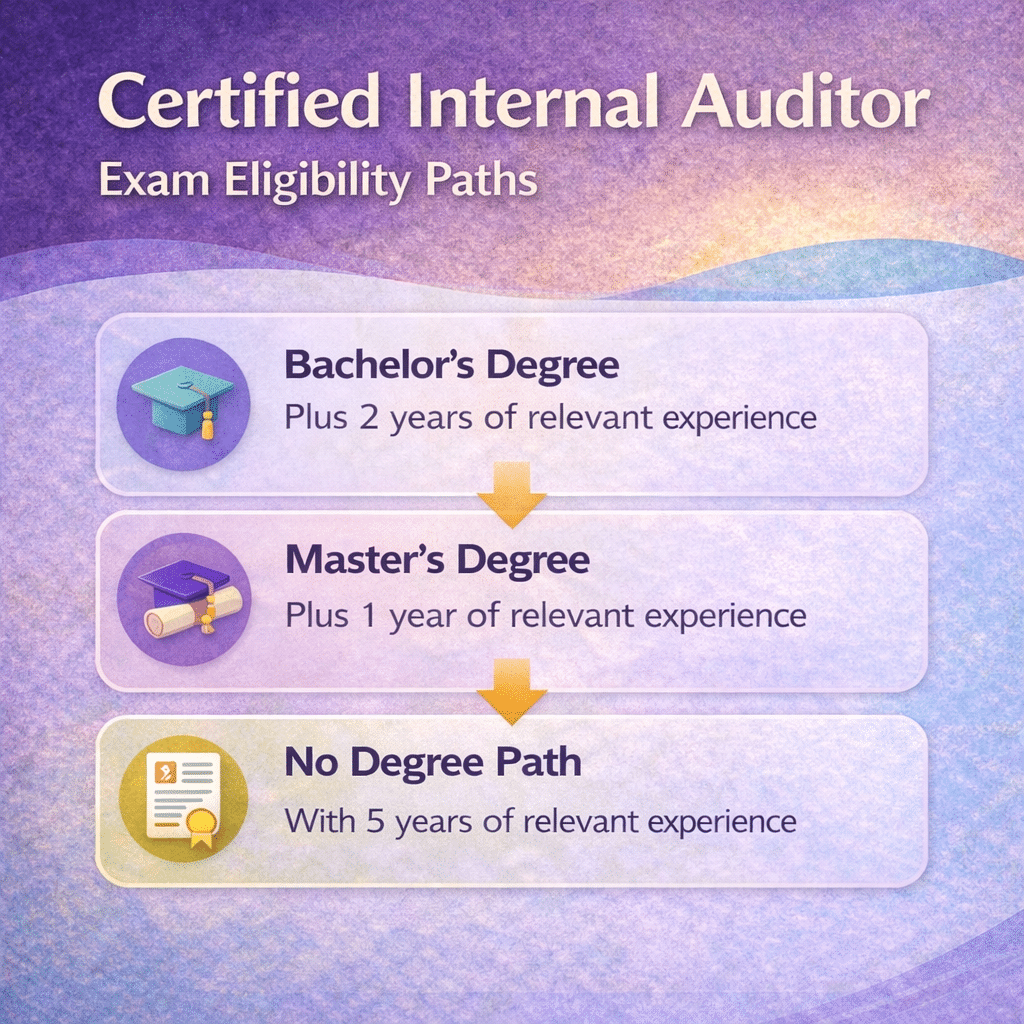
In general, candidates need to meet the requirements for one of these eligibility paths:
- Bachelor’s degree plus 2 years of relevant experience
- Master’s degree plus 1 year of relevant experience
- No degree path with 5 years of relevant experience
Relevant work can include internal audit, compliance, quality assurance, or risk management.
Then, they’d need to:
- Apply and get approved
- Register for the CIA exam
- Pass all three exam parts
- Meet ethics and program requirements
Some experienced professionals, including certain CPAs, CAs, and CISAs, may qualify for expedited pathways.
CIA Exam Basics: Format, Eligibility, Cost, And Timeline
The CIA exam has three parts, all multiple-choice:
- Part 1: Internal audit fundamentals, governance, risk, ethics, and fraud
- Part 2: Engagement planning, performing audit work, analysis, and communication
- Part 3: Business knowledge, including finance, IT, and management
Here’s the quick view:
| Factor | Details |
|---|---|
| Format | 3-part multiple-choice exam |
| Provider | The IIA |
| Eligibility | Education/experience requirements apply |
| Cost | Varies by IIA membership status and exam fees |
| Timeline | Many candidates finish within 12–18 months |
Costs change, so I’d always check the official IIA site before registering. Membership often reduces application and exam fees.
What To Expect From Salary, Job Growth, and Career Paths After Certification
Salary depends on experience, industry, and location, but the CIA can strengthen earning potential because it supports advancement into better-paying roles.
Common paths after certification include:
- Internal auditor
- Senior internal auditor
- Audit supervisor or manager
- Risk or compliance manager
- Director of internal auditing
Demand is strongest in heavily regulated industries like banking, healthcare, insurance, and government. Companies in those spaces need people who understand controls, documentation, and risk.
If I wanted to build a long-term career, the CIA could be a smart bridge credential: technical enough to open doors, but broad enough to support moves into leadership.
Final Verdict
If I wanted a career in internal auditing, once I met the education and experience requirements, I’d go for the CIA certification.
It’s respected, practical, and closely tied to real advancement (and yes, a higher salary).
And for me, that’s the key—not just passing an exam, but getting tangible value from it and building a lucrative, lasting career.
Ready for a career change? Check out these top CIA prep courses and see which is right for you.
FAQs
A Certified Internal Auditor is a professional certified by The Institute of Internal Auditors who evaluates an organization’s internal controls, risk management, governance processes, and compliance to improve operations and ensure regulatory adherence.
Earning the CIA credential enhances credibility, helps candidates stand out for senior internal audit and management roles, and is recognized globally, making it valuable for career advancement in audit, risk, compliance, and governance fields.
CIAs review processes and controls, assess financial and operational risks, test policy compliance, interview staff, analyze data for inefficiencies or red flags, and prepare audit reports with recommendations to improve organizational performance.
To qualify for the CIA certification, candidates need a bachelor’s degree plus 2 years of relevant experience, a master’s degree plus 1 year, or 5 years of relevant internal audit, risk, or compliance experience with no degree.
The CIA exam has three multiple-choice parts: Part 1 covers internal audit fundamentals, governance, risk, ethics, and fraud; Part 2 focuses on engagement planning, audit work, analysis, and communication; Part 3 addresses business knowledge, including finance, IT, and management.